
Calculators
BMI and Asian Standards — Why the Limits Are Stricter
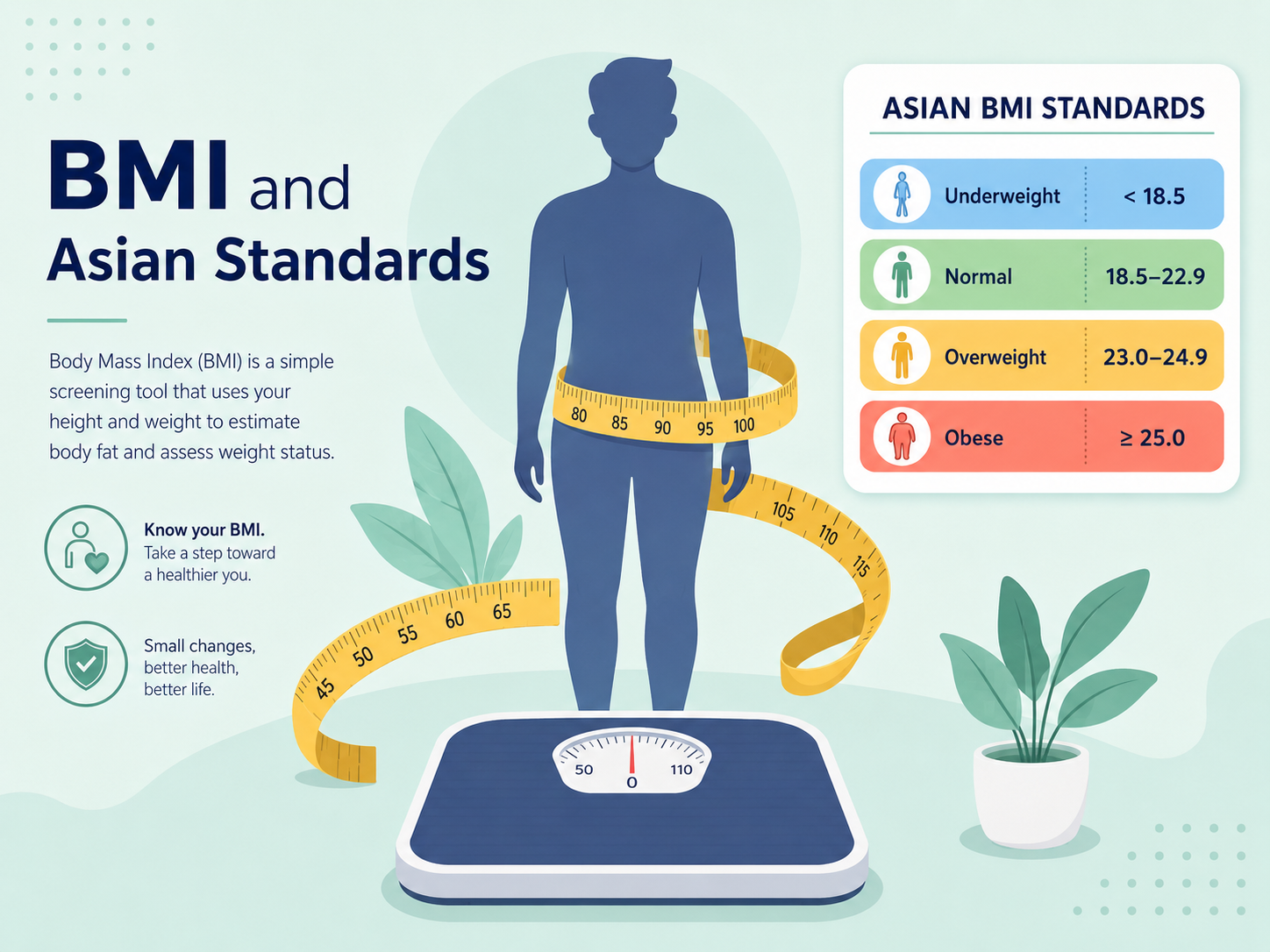
BMI is the most common quick measure of weight category from height and weight. But a BMI of 24 is 'normal' under WHO standards and 'overweight' under Korean and Japanese health authorities. The reason: body composition differs by ethnicity, and the cardiovascular risk at any given BMI is higher for East Asians than for Europeans.
How to calculate BMI
BMI = weight (kg) / height (m)². Someone 170 cm and 65 kg: 65 / (1.7 × 1.7) = 22.5. You can do it mentally — 1.7² ≈ 2.89, 65 / 2.89 ≈ 22.5.
The number itself matters less than which category you fall into. For East Asian descent, the Asian-Pacific thresholds matter more than the WHO global thresholds.
WHO global vs East Asian thresholds
| Category | WHO (global) | Korea / Japan / China |
|---|---|---|
| Underweight | < 18.5 | < 18.5 |
| Normal | 18.5 – 24.9 | 18.5 – 22.9 |
| Overweight | 25.0 – 29.9 | 23.0 – 24.9 |
| Obese class I | 30.0 – 34.9 | 25.0 – 29.9 |
| Obese class II | 35.0 – 39.9 | ≥ 30.0 |
| Obese class III (severe) | ≥ 40.0 | (merged) |
Why are Asian standards stricter?
Research consistently shows that at the same BMI, East Asian populations carry 3–5% more body fat on average than Europeans, with proportionally more abdominal fat. A Korean with BMI 24 has cardiovascular risk roughly comparable to a European with BMI 27.
The WHO has acknowledged this since 2004, publishing an alternate Asian-Pacific BMI scale. Korean and Japanese national health screening programs use the stricter scale by default.
Calculate your BMI
Enter height and weight, see both WHO and Asian-Pacific category in one click — useful for travelers and diaspora populations.
BMI & Body Fat CalculatorMetrics that complement BMI
- •**Waist circumference**: > 90 cm (men) or > 85 cm (women) signals abdominal obesity (Korean standard).
- •**Waist-to-hip ratio**: > 0.9 (men) or > 0.85 (women) increases cardiovascular risk.
- •**Body fat percentage**: Measured via BIA scale or DEXA scan. Target < 20% (men) or < 30% (women).
- •**Muscle mass**: Two people at the same weight can have very different muscle-to-fat ratios.
Frequently asked questions
My BMI is normal but I have a belly
Classic 'skinny fat' — normal BMI, high body fat percentage, low muscle mass. Combine BMI with waist circumference and body fat readings for an accurate picture.
Are athletes with BMI 25+ technically obese?
By the BMI number, yes — but medically, no. BMI doesn't separate muscle from fat. Sports physicians don't use BMI alone for athletes.
Does BMI work the same for children?
No. Kids and teens use age- and sex-specific percentile charts, since healthy BMI ranges shift during growth. BMI 24 is overweight for adults but can be normal for a 14-year-old.
Related tools
Do the thing this article describes.