
Calculators
Compound Interest — Why Time Beats Contribution
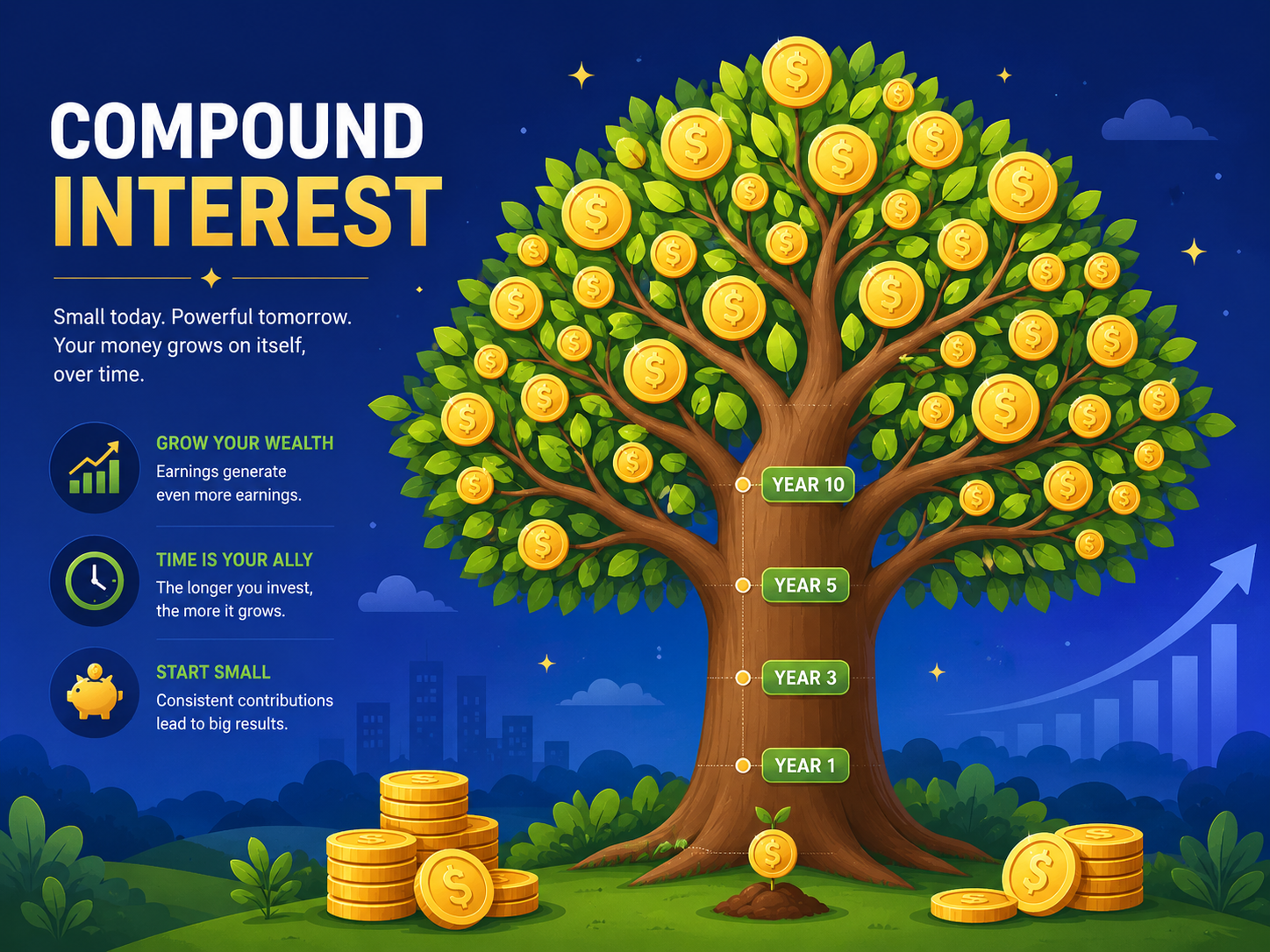
Einstein supposedly called compound interest 'the eighth wonder of the world.' The math is simple — earn interest on your interest — but the long-term outcome is wildly counterintuitive. $500/month for 30 years at 5% becomes $416,000. The principal is only $180,000; the rest is compounding doing the heavy lifting.
Compound vs simple — diverges fast
Simple interest pays you only on the principal each period. Compound interest pays you on the principal plus all previously earned interest. Year 1, the two look identical. By year 5 the gap starts to widen, year 20 it's 50% bigger, year 30 it's roughly double.
Most bank deposits in the US compound monthly or daily. Read the fine print — a few savings products advertise the same rate but use simple interest, which produces dramatically less over time.
$500/month at 5% compound — by horizon
Notice how interest as % of total grows over time.
| Years | Total contributions | Final balance | % from interest |
|---|---|---|---|
| 10 | $60,000 | ~$77,500 | 23% |
| 20 | $120,000 | ~$205,000 | 42% |
| 30 | $180,000 | ~$416,000 | 57% |
| 40 | $240,000 | ~$760,000 | 68% |
Model your own savings
Enter monthly contribution, duration, and interest rate to see the final value. Compares simple vs compound, with optional inflation adjustment.
Compound Interest CalculatorThe hidden traps — fees and inflation
Compounding works against you too. A 1% annual mutual fund fee, compounded across 30 years, reduces your final balance by ~25%. Switching to a low-cost index fund (0.1–0.3% expense ratio) routinely adds tens of thousands to retirement balances.
And inflation eats real returns. 5% nominal return minus 3% inflation = 2% real return. The $416,000 above, at 3% inflation, has the purchasing power of about $170,000 in today's money. Always think in real (after-inflation) terms for long horizons.
Five ways to maximize compound growth
- •**Start early**: Five extra years can mean 30–50% more at retirement.
- •**Contribute regularly**: Dollar-cost averaging beats trying to time markets.
- •**Minimize fees**: Index funds (0.1–0.3%) beat actively managed funds (1–2%) by huge margins over decades.
- •**Automate**: Don't rely on willpower — set up automatic transfers.
- •**Use tax-advantaged accounts**: 401(k), IRA, Roth (US) or ISA/pension equivalents elsewhere.
Frequently asked questions
Does monthly vs annual compounding matter much?
Slightly — 5% compounded monthly equals about 5.12% effective annually. Small per-year, but meaningful over decades.
Does stock investing compound?
Reinvested dividends compound directly. Pure capital gains compound through accumulated equity. Note: compound mechanics also work negatively during downturns.
Bank savings rates are so low — is it still worth it?
For your safety bucket, yes. But if the rate doesn't beat inflation, you're losing purchasing power. For long-term growth, you need equity exposure (index funds, ETFs, etc.).
Related tools
Do the thing this article describes.