
Calculators
How to Avoid Currency Conversion Fees — 5 Practical Rules
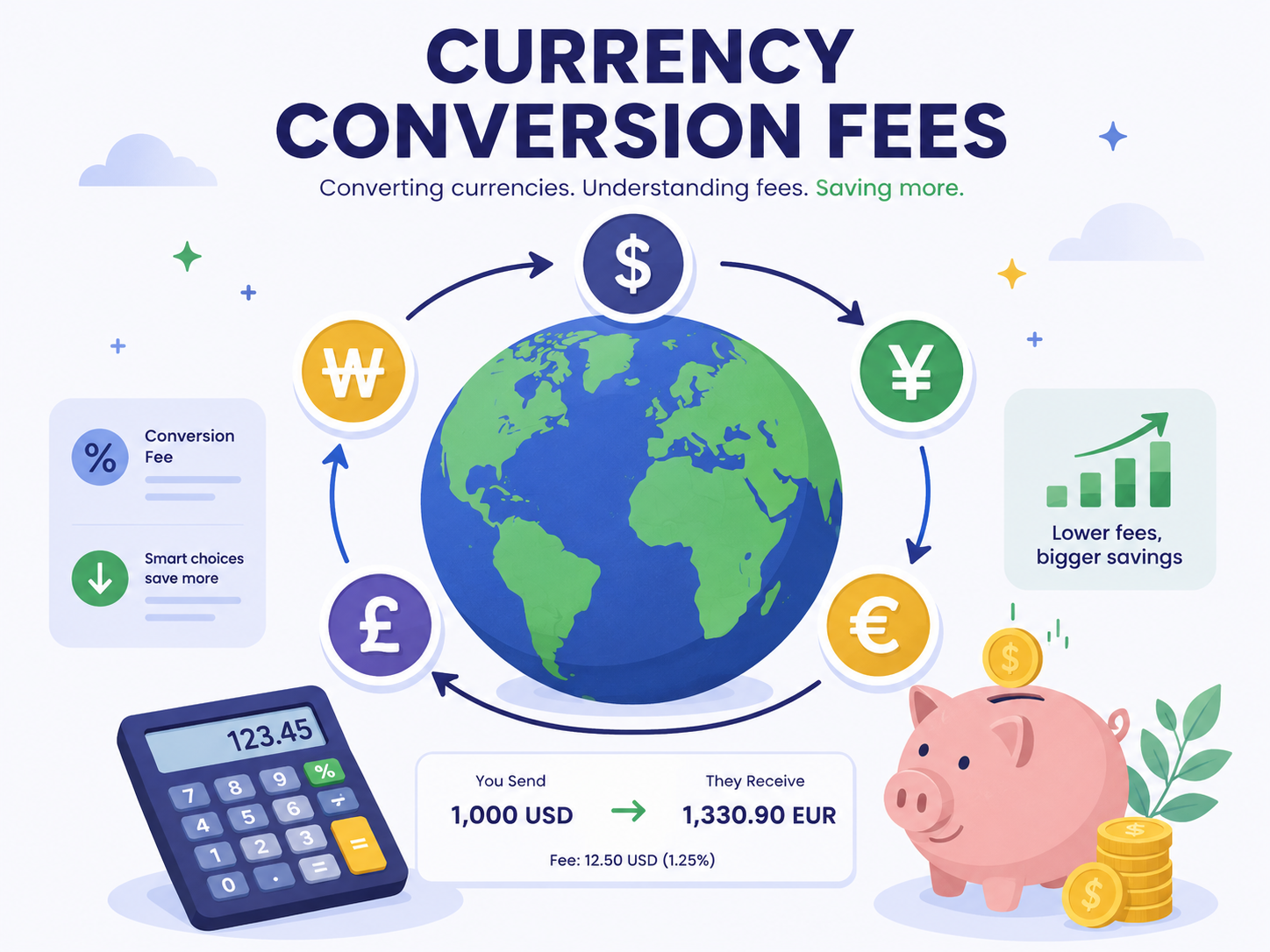
The mid-market rate you see on Google isn't the rate you actually get when you exchange or pay abroad. The 4–8% difference is the bank's spread, the card network's markup, and sometimes a 'dynamic currency conversion' fee on top. On a $1000 transaction, that's $40–80 — far from trivial.
Effective spreads by exchange method
Approximate spread above the mid-market rate (varies by region/bank).
| Method | Spread | Notes |
|---|---|---|
| Bank counter exchange | ~1.5–2% | Standard tourist rate |
| Bank app online exchange | ~0.2–0.5% | Often best for in-country pickup |
| Travel cards (Wise, Revolut) | 0–0.5% | Best for both spending and ATM |
| Airport currency exchange | 5–8% | Avoid unless emergency |
| Hotel front desk | 8–15% | Always the worst |
Five rules that save real money
- 1
Skip airport and hotel exchange
Their 5–15% spreads make them the most expensive option. Often cheaper to just use a card upon arrival.
- 2
Use a travel card
Wise, Revolut, and similar give near-mid-market rates plus free ATM withdrawals abroad. Top up before you travel.
- 3
Online exchange beats counter exchange
Even at the same bank, the app rate is usually 0.5–1% better than the counter rate. Reserve online, pick up at branch.
- 4
Always pay in local currency at terminals
When a payment terminal asks 'pay in your home currency or local currency?' choose local. The 'home currency' option triggers Dynamic Currency Conversion — a 3–8% extra fee.
- 5
For international transfers, use a specialist
Bank wire transfers cost $20–50 plus 1.5–3% spread. Wise charges ~0.5% at mid-market rates for the same job.
Check current rates
Real-time mid-market rates for 200+ currencies. Use this as a reference — subtract the spread above to estimate what you'll actually receive.
Currency ConverterFrequently asked questions
Cash exchange beforehand vs card abroad — which is better?
Depends on the destination. Travel cards usually win because they give near-mid-market rates for both purchases and ATM withdrawals. Cash is essential for cash-only countries (Cuba, parts of rural Southeast Asia).
Should I keep money in a foreign-currency account?
Useful for predictable foreign expenses (overseas tuition, planned trips). For speculative currency trading, the fees usually outweigh any gains for retail investors.
What fees apply to online international purchases?
Card network fee (~0.18% Visa/Mastercard) + foreign transaction fee (1–3% depending on card) + exchange spread (0.5–1%). Total 2–3%. Travel cards waive most of these.
Related tools
Do the thing this article describes.