
Regional Guides
Business Days in Korea — Holidays and Substitute Days
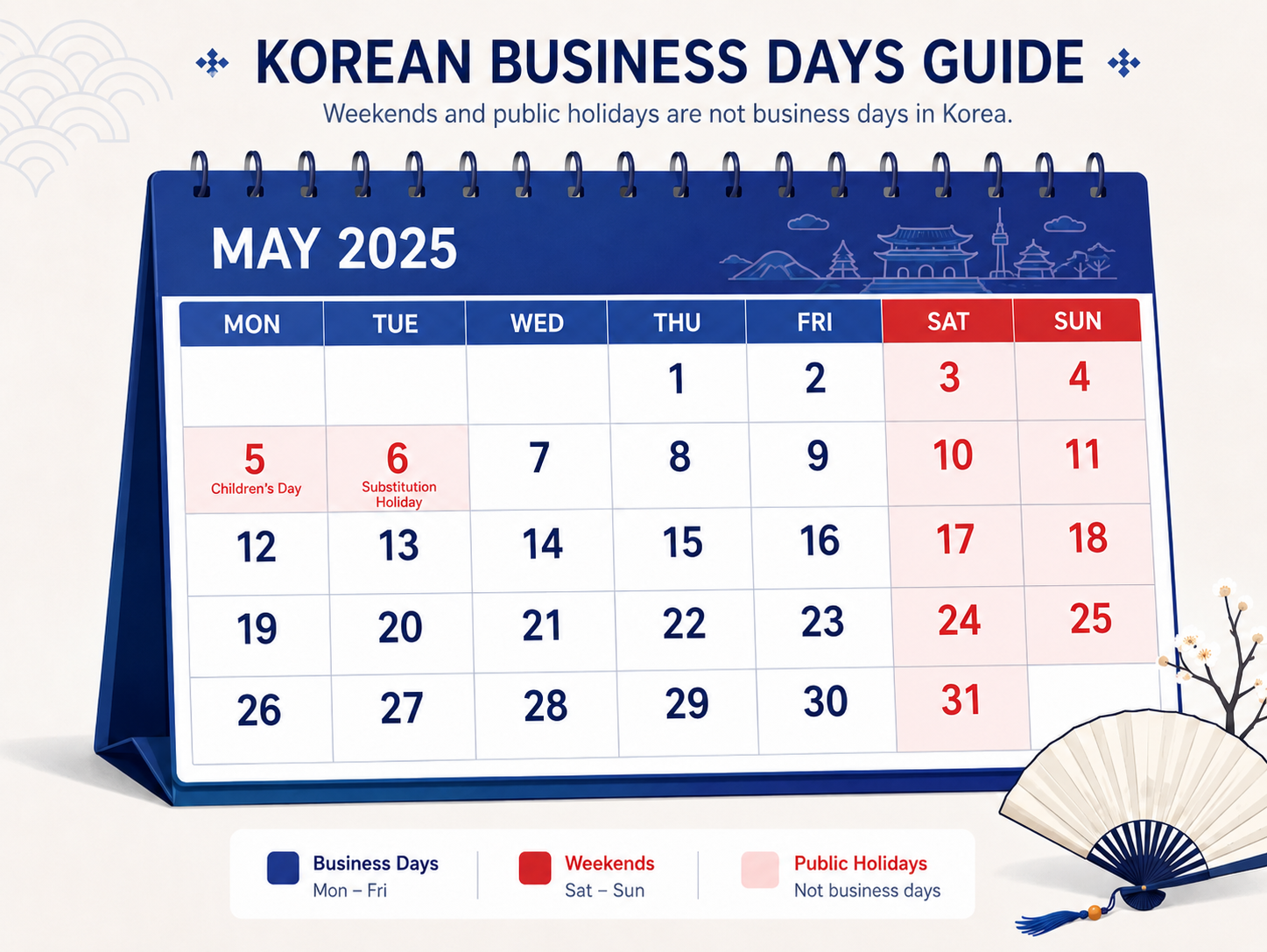
Korean business systems use 영업일 (business day) for shipping, banking, and government processing times. The number takes out weekends, public holidays, and 'substitute holidays' — Korea has 14–15 holidays a year and a rule that pushes some of them to a weekday if they fall on a Sunday.
What counts as 'not a business day' in Korea
**Weekends**: Saturday and Sunday (most institutions).
**Public holidays**: 14–15 per year (Lunar New Year, Chuseok, Independence Day, Children's Day, etc.).
**Substitute holidays**: When a public holiday falls on a Sunday or overlaps another holiday, the next weekday becomes the holiday. Introduced in 2014.
**Temporary holidays**: Government-declared (e.g., election days, occasional commemorations).
Korea has slightly fewer business days than the US — about 250 vs the US's ~252.
Major Korean public holidays (2026 reference)
Mix of fixed and lunar-based dates. Substitute holiday rules apply to some but not all.
| Holiday | Date | Notes |
|---|---|---|
| New Year's Day | Jan 1 | Fixed |
| Seollal (Lunar New Year) | Lunar 12/31–1/2 (3 days) | Variable |
| Independence Movement Day | Mar 1 | Fixed |
| Children's Day | May 5 | Substitute holiday eligible |
| Buddha's Birthday | Lunar Apr 8 | Variable |
| Memorial Day | Jun 6 | Fixed (no substitute) |
| Liberation Day | Aug 15 | Substitute holiday eligible |
| Chuseok | Lunar 8/14–16 (3 days) | Variable |
| National Foundation Day | Oct 3 | Substitute holiday eligible |
| Hangul Day | Oct 9 | Substitute holiday eligible |
| Christmas | Dec 25 | Fixed (no substitute) |
Calculate business days
Enter start date, end date, or business-day count. Auto-handles Korean, US, and Japanese holidays. Useful for shipping, transfers, deadlines.
Business Days CalculatorThe substitute holiday rule, explained
Introduced in 2014, the substitute holiday rule applies when an eligible public holiday falls on a Sunday (or another holiday). The next non-holiday weekday becomes a holiday too. **Eligible holidays**: Seollal, Chuseok, Children's Day, Liberation Day, National Foundation Day, Hangul Day.
**Not eligible**: New Year's Day, Independence Movement Day, Memorial Day, Christmas, Buddha's Birthday. These just lose their holiday status if they hit a weekend.
**Example**: If Children's Day (May 5) falls on a Sunday, the following Monday (May 6) becomes a holiday.
Where business-day math matters
- •**International transfers**: '2 business days' = excludes weekends and Korean holidays
- •**Shipping**: '1–3 business days' = no weekend dispatch, weekday transit only
- •**Government applications**: '7 business days' processing = real elapsed time often 10+ calendar days
- •**Trade deals (L/C, etc.)**: '30 business days' should account for both countries' holiday calendars
- •**Refunds**: '14 business days' often means 18–20 calendar days including weekends
Frequently asked questions
How many business days are in a typical Korean year?
Roughly 250–252, depending on how Seollal and Chuseok fall. One week = 5 business days; one month ≈ 22 business days.
How do international transactions handle holidays?
Both countries' calendars apply. If today is a Korean holiday but a US business day, US banks operate but Korean ones can't receive. Always check both sides.
Are temporary holidays announced in advance?
Usually 1–2 months before, by Ministry of Interior. Calendar tools update as soon as announced. Always allow some buffer for last-minute additions.
Related tools
Do the thing this article describes.